Why high income no longer guarantees breathing room
There’s a strange financial tension happening across Australia.
On paper, many households are earning more money than ever before.
Higher salaries.
Dual incomes.
Career progression.
Better jobs.
And yet, plenty of people earning good money still feel financially tight.
Not broke.
Not irresponsible.
Not failing.
Just… stretched.
The old relationship between income and breathing room has changed.
For a long time, earning more money usually created more margin.
More flexibility.
More options.
More room to move.
Today, that equation can look very different.
Because financial pressure rarely comes from one big expense.
It comes from everywhere at once.
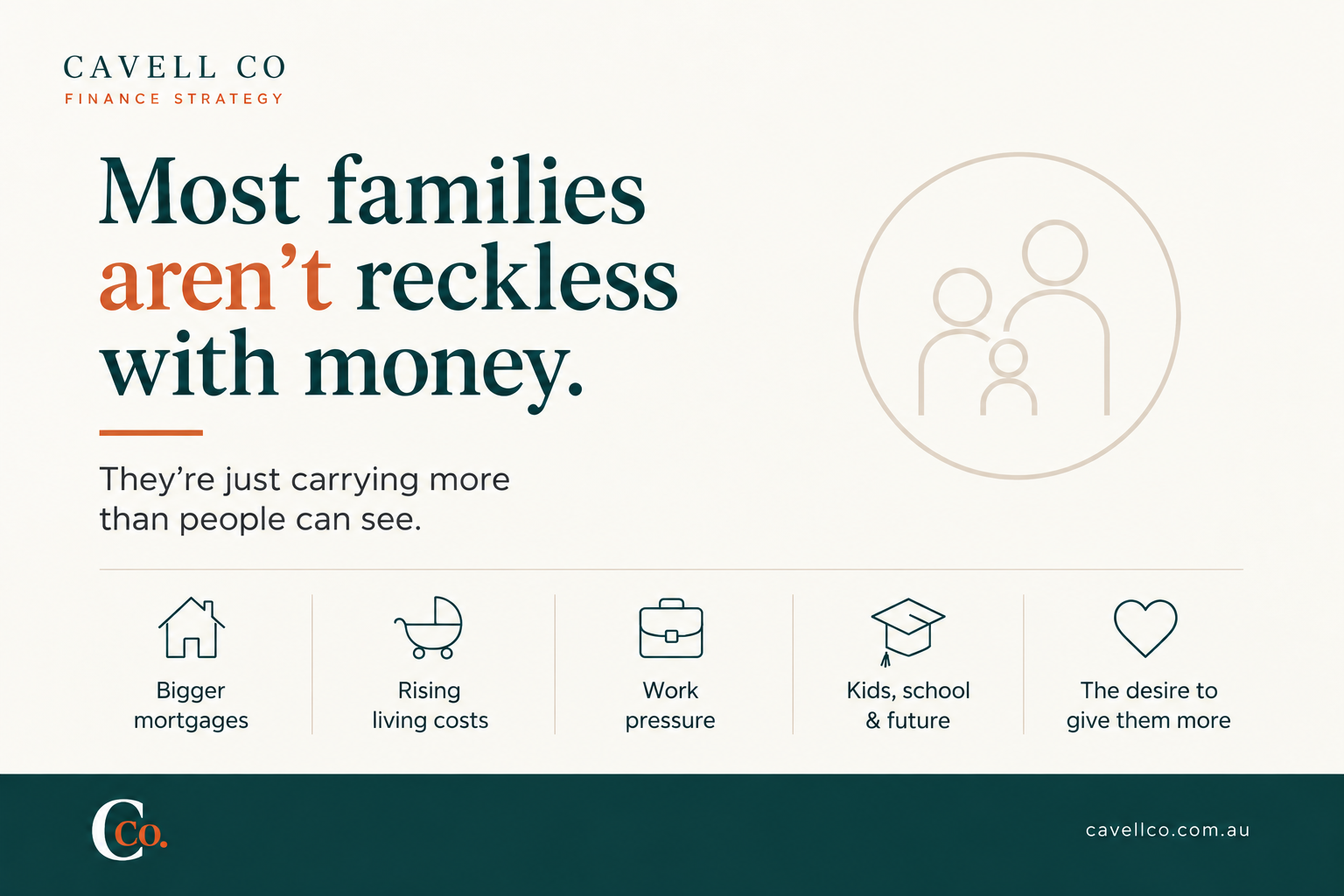
Cavell Co finance strategy graphic explaining that families aren’t reckless with money, highlighting bigger mortgages, rising living costs, work pressure, children’s futures and the desire to provide more.
Good income doesn’t always mean strong cash flow
Housing costs have risen.
Mortgage repayments take up a larger chunk of many household budgets.
Then there’s childcare. Insurance. Groceries. Utilities. School costs. Cars. Home maintenance.
And quietly, lifestyle costs accumulate too.
Subscriptions.
Sport for the kids.
Streaming services.
Weekend spending.
Eating out because everyone is exhausted.
None of these things individually destroys a household budget.
But collectively?
They can slowly consume the margin that a higher income was supposed to create.
That’s why a household can earn what looks like a very healthy income and still wonder:
“We earn good money – so why does it still feel this hard?”
Sometimes the problem isn’t income
For many households, earning more isn't necessarily the immediate answer.
The problem can be structure.
Over time, life evolves and financial commitments accumulate.
A bigger mortgage.
A growing family.
A new car.
Schooling.
Renovations.
Lifestyle upgrades.
Investment properties.
Business expenses.
Most of these decisions can make perfect sense individually.
But rarely do we stop and look at what they’re doing collectively.
Eventually, the margin gets smaller.
And that's often when people start questioning their mortgage, their spending, their property plans – or whether they're actually in the financial position they thought they were.
Income and borrowing capacity aren't the same thing
This becomes particularly important when you're thinking about your next property move.
A strong salary doesn't automatically translate into unlimited borrowing capacity.
Lenders also consider things like:
existing mortgage commitments
credit card limits and other debts
dependants
living expenses
investment property commitments
loan terms and interest rates
the type and consistency of your income
So two households earning exactly the same amount can have very different borrowing positions.
And even if a lender is prepared to approve a certain amount, there's another question worth asking:
How much should you actually borrow?
Those are two very different conversations.
More debt isn't automatically the answer either
This is where I think good mortgage advice needs to go beyond finding a competitive rate.
If you're refinancing, accessing equity, upgrading your home or buying an investment property, the question shouldn't simply be:
“How much can I borrow?”
It should also be:
“What does this decision do to the rest of my financial position?”
Will you still have a healthy cash buffer?
What will the repayments actually feel like each month?
Does the loan structure give you flexibility?
Could this decision restrict your ability to make another property move later?
Would refinancing genuinely improve your position – or are you moving lenders for a relatively small benefit?
Sometimes the right answer is another loan.
Sometimes it's restructuring the debt you already have.
And sometimes the smartest move is doing absolutely nothing yet.

Cavell Co finance strategy graphic, highlighting financial breathing room and the importance of building a sustainable long-term strategy.
Financial breathing room is partly about structure
Financial confidence rarely comes from income alone.
It usually comes from understanding your numbers and knowing what you're trying to achieve.
That might mean:
understanding where your money is actually going
reviewing the structure of your existing loans
reducing unnecessary financial commitments
maintaining a genuine cash buffer
understanding your borrowing capacity before shopping for property
planning the next move before taking on more debt
The goal isn't necessarily to squeeze every possible dollar out of the household budget.
It's to create enough margin that financial decisions stop feeling reactive.
Because two households earning the same income can experience completely different levels of financial pressure.
One can feel trapped.
The other can feel relatively calm.
Not necessarily because one earns more.
Because their financial structures are different.
Before making your next move
If you're earning good money but still feel financially stretched, it may be worth looking at the whole picture before assuming you simply need to earn more.
What are your current commitments?
How much breathing room do you actually have each month?
Is your mortgage structured appropriately?
What does your borrowing position look like today?
What are you trying to achieve over the next few years?
And does your next financial or property decision move you closer to that – or simply add another commitment?
That’s the kind of work I believe should happen before jumping straight to a lender or another loan.
Because clarity changes the quality of the decision.
And good financial decisions compound over time.
– Cavell Co
If you're earning good money but still feel like there should be more breathing room, the Cavell Co Blueprint Session is designed to help you understand where you stand, what's creating the pressure and what your next move could look like.
